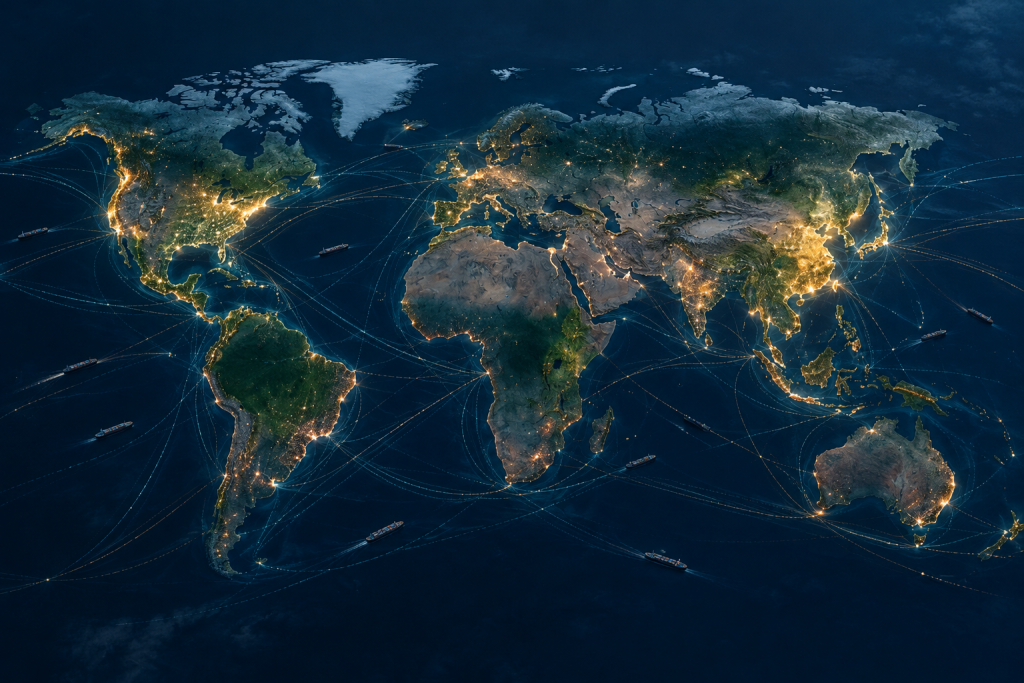
Why can the world be growing and still be in a recession?
The world's total output almost never shrinks. Population keeps growing, and fast-growing countries keep adding to the total. If "global recession" meant a smaller world economy, it would almost never happen.
So economists change the measure. GDP, or gross domestic product, is the value of everything a country makes and sells in a year. The World Bank and the International Monetary Fund (IMF), the two main global economic institutions, look at GDP per person. They call it a global recession when real world GDP per person falls over a year. "Real" means adjusted for rising prices.
The fall also has to hit many big economies at once. It comes alongside drops in factory output, trade, jobs and the flow of investment money.
Picture a school that adds 30 new students. Its total test points can climb while every student's score drops. The per-person measure asks whether the average person has less to work with.
The U.S. has an official scorekeeper for its own economy: the NBER, a private group of economists that dates U.S. recessions. The world has none, so the World Bank and IMF apply their criteria after the fact.
Only five times since World War II
By the World Bank's count, the world has had five global recessions since World War II: 1975, 1982, 1991, 2009 and 2020.
Milder slumps get a different label. Economists call 1958, 1998, 2001 and 2012 global downturns, or growth recessions, because output per person still grew in those years, only far below normal. In 2020 the pandemic closed businesses in most countries at nearly the same time, and the World Bank later published a set of charts just to measure how deep that year went.
How a crisis far away reaches a U.S. paycheck
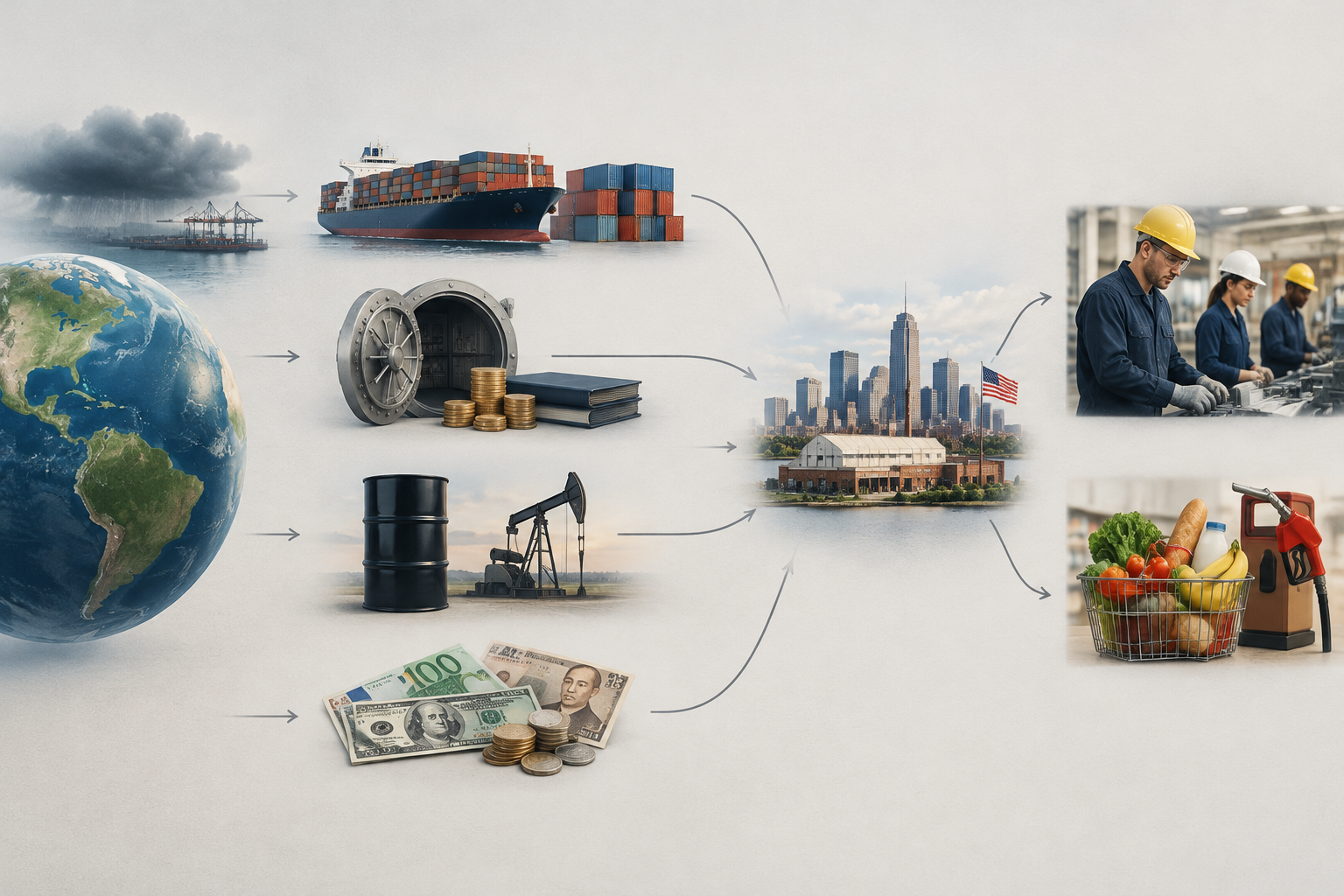
Trade is the most direct route. When families and companies abroad buy less, U.S. factories and farms that sell overseas see orders shrink, which can mean fewer hours or fewer hires.
Credit travels too. When a crisis hits one region, lenders there pull back, and borrowing gets harder and costlier for businesses everywhere.
Energy prices work faster. A war or supply disruption that pushes oil up raises costs for nearly every business, and the IMF links today's elevated inflation to energy prices and shipping disruption.
In a scare, investors often rush into the U.S. dollar. A stronger dollar makes American products pricier abroad and shrinks the dollar value of what U.S. companies earn overseas.
Where things stand now
In its October 2026 World Economic Outlook, the IMF projects world growth of 3.1% in 2026 and 3.4% in 2027. It puts global inflation near 4.7% in 2026, mainly because of energy prices and shipping disruption. That is slow growth with prices still rising fast, which squeezes budgets even when nothing is shrinking.
By the formal test, this is not a global recession. The test looks at output per person, and the IMF still expects the world economy to grow faster than its population, so output per person is projected to rise. That is the line I'd watch, not the headline total.
Still, economists often say world growth below about 2.5% to 3.0% feels like a recession, especially in rich countries. That is a rough habit of speech, not an official line, and 3.1% sits just above it.
The world average also hides who is struggling. Slumps can roll from place to place: European manufacturing and Chinese real estate have been weak while U.S. services and AI-related tech infrastructure kept growing. The world number stays positive, so no global recession is declared even though some industries and regions are having a bad stretch. One small business owner posting in May 2026 said clients answered an oil price spike by dragging out project reviews instead of canceling, which kept cash in their pockets and left vendors waiting.
The IMF names war, trade policy and energy shocks as the main risks. Its April 2026 analysis said war was darkening the outlook, and its October commentary describes the global economy's resilience as under strain. Any one of those could turn a slow year into a falling one, because the forecast leaves little cushion.
Warning lights people watch
For the world, the PMI is the better first check. That is the Purchasing Managers' Index, a monthly survey of company purchasing managers, where a reading below 50 means shrinking activity. A simultaneous drop in the U.S., the Eurozone and China suggests demand is falling across borders.
Claudia Sahm, a former Federal Reserve economist, built a rule around the U.S. unemployment rate. If the three-month average rises 0.50 percentage points or more above its lowest point in the past 12 months, a U.S. recession is probably starting. It reads only the U.S. job market, and fast immigration can push unemployment up without mass layoffs.
The yield curve compares what the U.S. government pays to borrow for short and long periods. When short-term borrowing costs more than long-term, bond investors are signaling worry. The curve often returns to normal just as central banks cut rates in response to a weakening economy, so that return can mark the start of a recession, not the all-clear.
Material claims should be traceable to appropriate sources. Corrections are made when new evidence materially changes an article.