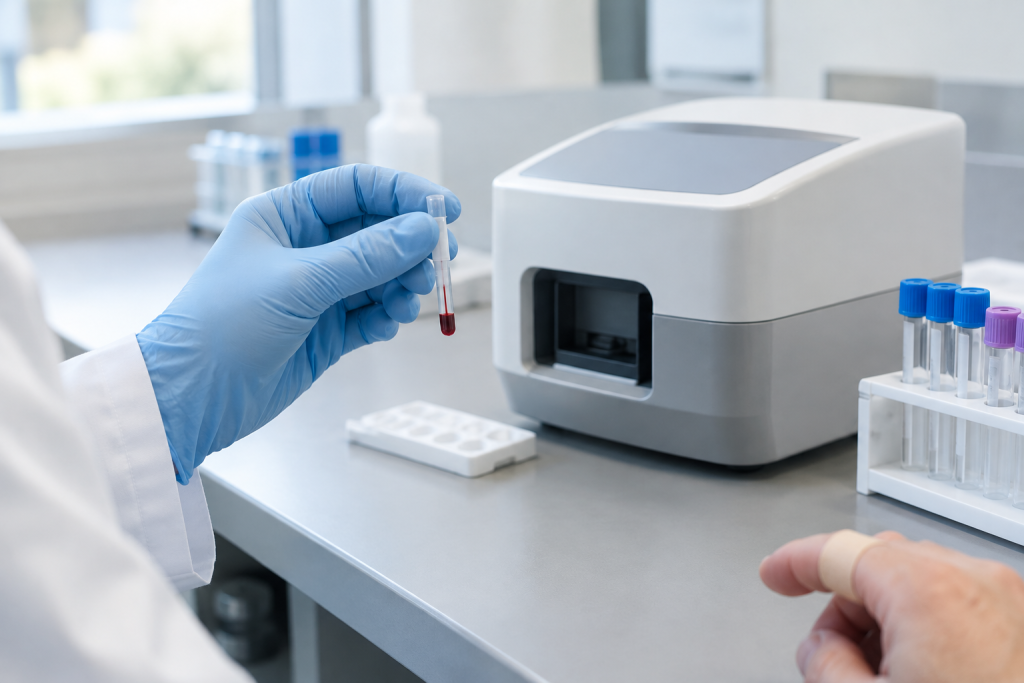
A few drops of blood, hundreds of tests
Getting blood tested usually means a nurse, a needle in your arm and several vials. Theranos promised something much smaller: a prick on your fingertip, a few drops of blood, and results for hundreds of conditions. Elizabeth Holmes founded the company in 2003 after dropping out of Stanford University.
The machine at the center of the pitch was called Edison. A diagnostic test is a lab measurement that helps a doctor judge your health, such as blood sugar or cholesterol. Theranos said Edison could run hundreds of them from one fingerstick sample.
In October 2015, The Wall Street Journal published reporting that questioned whether the technology worked. Federal investigations followed and the company collapsed. In 2018, prosecutors charged Holmes and Ramesh "Sunny" Balwani, Theranos's former president and chief operating officer, with fraud.
What the machines were really doing
The heart of the case is a gap between what investors were shown and what happened in the lab. Trial exhibits showed Holmes directing the secret modification of commercial analyzers made by Siemens. Staff ran diluted blood samples on those machines instead of relying on Theranos's own device, while investors were shown Theranos machines.
Two former employees described the problem from inside. Erika Cheung, a lab assistant who worked on Edison and the modified Siemens machines from October 2013 to April 2014, testified that the Theranos device repeatedly failed quality-control checks. Staff then deleted data points or diluted the tiny samples so they could run on the commercial analyzers. She later filed a complaint with the federal agency that oversees lab standards.
Adam Rosendorff, the lab director from April 2013 to November 2014, testified that he warned Holmes that Edison's potassium, glucose and sodium results were unreliable. He resigned after his concerns met resistance.
Patients were on the receiving end. Brittany Gould, an Arizona medical assistant, testified that Theranos pregnancy-hormone results in 2014 suggested she had miscarried. Tests at traditional labs showed the pregnancy was intact.
Theranos also refused to let technical staff from Walgreens, its retail pharmacy partner, see inside the Edison lab. It cited trade secrets.
Regulators acted too. In 2015 the FDA, which oversees medical devices, flagged Theranos's "nanotainer" blood-collection tube as an uncleared medical device. In 2016 the Centers for Medicare & Medicaid Services (CMS), the federal agency that runs Medicare and Medicaid and also inspects labs, revoked the certificate that Theranos's Newark, California, lab needed to test human samples. CMS also banned Holmes from owning or running a lab for two years.
What did the jury actually decide?
Holmes was not convicted of harming patients. The jury cleared her on every count that involved individual patients.
On January 3, 2022, the jury returned a split verdict, meaning it agreed on some charges and not others. It found her guilty on 4 counts: one count of conspiracy to commit wire fraud, and three counts of wire fraud against investors. Wire fraud means using electronic communications, such as emails or bank transfers, as part of a scheme to cheat people out of money. The jury acquitted her on the 4 counts about patients. On 3 other investor counts, jurors could not reach a decision, which is what "deadlocked" means.
So the legal finding is that she defrauded investors, including the DeVos family's investment vehicle. The bad patient results are part of the story, but the jury did not convict her for them.
Her defense said she was in an abusive relationship with Balwani that clouded her judgment. Balwani denied the allegations. Prosecutors pointed to text messages and company communications that they said showed Holmes making decisions herself.
Sentence, restitution, and a failed appeal
On November 18, 2022, U.S. District Judge Edward Davila sentenced Holmes to 135 months in federal prison, which is 11 years and 3 months. After that comes three years of supervised release, a period of check-ins with a probation officer once she is out. In May 2023 he ordered her to pay $452,047,268 in restitution, which is money paid back to victims.
The order makes her and Balwani "jointly and severally" liable. Think of two friends who break a window and are each responsible for the whole repair bill. Whatever Balwani pays reduces what Holmes still owes, and the other way around.
She had settled earlier with the SEC, the federal agency that polices investment markets, accepting a 10-year ban from serving as an officer or director of a public company in March 2018 without admitting or denying guilt.
Her appeals failed. On February 24, 2025, a three-judge panel of the Ninth Circuit Court of Appeals upheld her conviction, prison term and restitution. On May 8, 2025, the full court unanimously denied her request for a rehearing.
Where she is now and when she could leave
Holmes has been held since May 30, 2023, at Federal Prison Camp Bryan in Texas, a lower-security women's facility.
On March 26, 2026, Judge Davila cut her sentence by 12 months, from 135 to 123 months, which is 10 years and 3 months. He used Amendment 821, a change to the federal sentencing guidelines, the rules that steer how long a sentence should be. The change applies retroactively to "zero-point offenders," people with no prior criminal history.
Based on the Bureau of Prisons' calculations, her projected release date is February 22, 2030. That is a projection, and it can move as the bureau updates her credits. Records from the Justice Department's victim notification system also show she is approved to move to the Austin Transitional Center, a halfway house in Texas, on August 23, 2027. A halfway house is a supervised residence for the end of a sentence, so she would still be serving time.
None of this is early parole. The federal system has had no parole since the Sentencing Reform Act of 1984. Her dates come from arithmetic: the shorter resentenced term, minus credits under the First Step Act, a 2018 federal law that lets inmates earn time off by completing programs, and minus good conduct time, days taken off for good behavior.
Material claims should be traceable to appropriate sources. Corrections are made when new evidence materially changes an article.