The story most people have heard
The popular version goes like this: Halloween is a pagan festival from ancient Celtic times, and it survived almost unchanged. It is a good story, but the records do not support it.
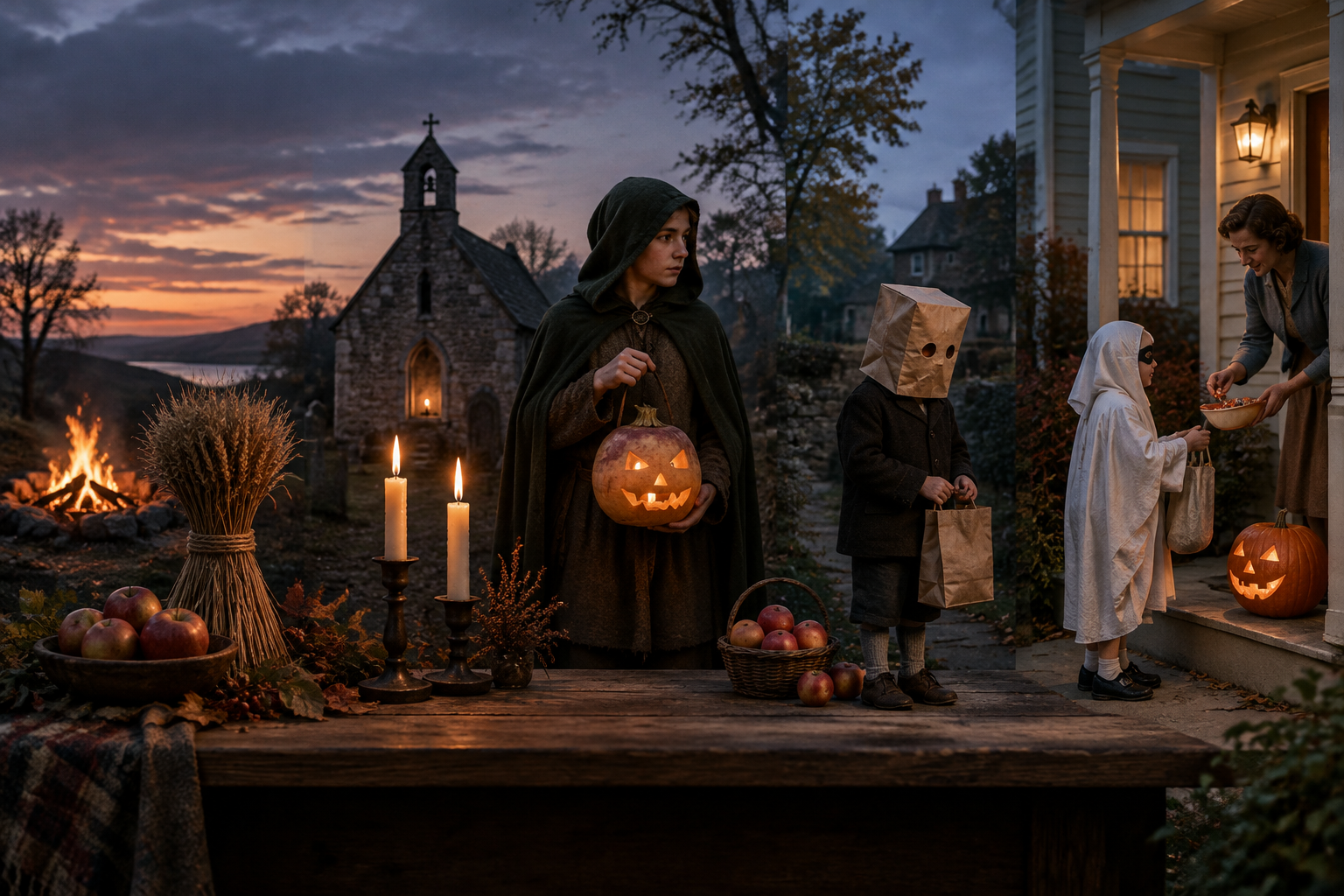
Halloween is a blend of several streams. The oldest is Samhain (say it SOW-in), a Gaelic festival marking the start of winter. Next came the medieval Christian feast days of November 1 and 2. Then came British and Irish folk customs like costumes and carved lanterns. Last came America, which turned all of this into the trick-or-treat holiday we know.
Samhain: the Gaelic end of summer
Samhain comes from Old Irish words usually read as "summer's end." Early Irish tradition split the year into two halves. Summer began at Beltane on May 1, and winter began at Samhain on November 1. The festival started at sunset on October 31.
It was a practical date as well as a spiritual one. Herds came down from summer pastures. Extra meat was slaughtered and salted for winter. Tribes held big gatherings, and hilltop bonfires were lit, including at Tlachtga, the Hill of Ward in County Meath.
Irish stories also treated Samhain as a doorway. The line between this world and the Otherworld, home of the fairy folk, was thought to thin, and heroes in the tales often met prophecies or deaths at this time.
Almost everything we know about Samhain comes from early Irish literature, written down centuries after the events it describes. Claims about exactly what people did at ancient Samhain rituals are far shakier than the confident versions online suggest.
That is why the one myth worth dropping is "Lord Samhain, god of the dead." Samhain names a season and, in modern Irish, the month of November. No early Celtic deity has that name. The idea traces to Charles Vallancey, a British surveyor, who invented the god in 1786 in a book about Irish history. Later scholars of language took the claim apart.
How the church calendar shaped it
The word Halloween is a church word. In Middle English, All Saints' Day, November 1, was All Hallows' Day, from an Old English word for holy person. The night before was All Hallows' Eve, which squeezed over the centuries into Hallowe'en.
The feast grew in steps. Pope Gregory III, who led the church from 731 to 741, consecrated a chapel at St. Peter's to all saints on November 1. In 837, Pope Gregory IV ordered the feast observed across the Holy Roman Empire. Around 998, Odilo, abbot of the monastery at Cluny, set aside November 2 as All Souls' Day to remember all the faithful dead. Together, October 31 to November 2 became Allhallowtide, a three-day season of remembering the dead.
All Souls' Day gave rise to souling. Poor villagers and children went door to door in the late Middle Ages, offering prayers and songs for souls in purgatory, in exchange for soul cakes, small spiced baked goods. It is easy to see an ancestor of trick-or-treat here.
A widely repeated claim says the church picked November 1 to overwrite Samhain. Sir James Frazer promoted that idea in The Golden Bough in 1890. Modern historians such as Ronald Hutton question it. Their point is that November 1 was already observed in England and Germany before the date reached Ireland, so the church was not simply chasing a Gaelic festival.
I'd go with the hybrid account. Gaelic ideas about winter's start and a thin border with the Otherworld sit alongside a Christian calendar of saints and souls. The pure-pagan version needs more written evidence than anyone has, and the pure-church version ignores the Irish and Scottish customs that followed.
Costumes, turnip lanterns, and love games in Britain and Ireland
By the 1500s to 1700s, young people in Scotland and Ireland were guising at Halloween: dressing up, sometimes with blackened faces, and performing songs, poems, or jokes for food, fruit, or coins.
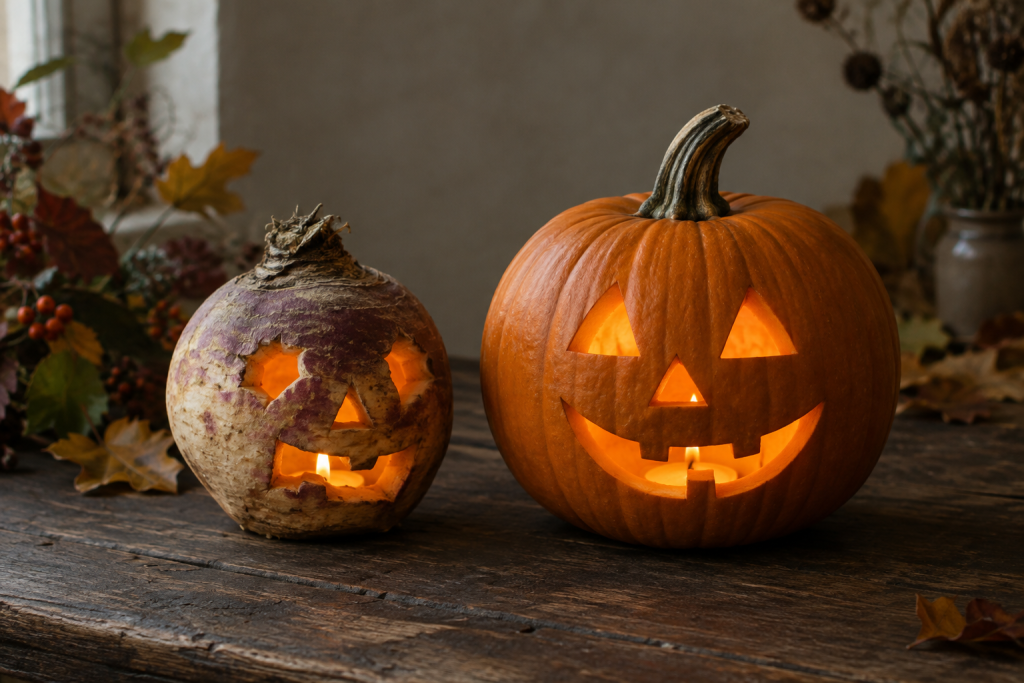
The jack-o'-lantern started as an English dialect word for the will-o'-the-wisp, the eerie light seen over marshes. It was later used for hollowed root vegetables, mostly turnips, carved with grim faces and lit with a coal or candle. The Irish tale of Stingy Jack explains the name: a rogue who tricked the Devil, was refused by both Heaven and Hell, and wandered with an ember in a turnip. That is folklore, not documented history. Some modern carvers say turnips are far tougher to cut than pumpkins, which helps explain the later switch.
Halloween was also a night for love games. Robert Burns's 1785 poem Halloween describes roasting pairs of hazelnuts to test whether lovers stayed true, and bobbing for apples was a harvest game with the same fortune-telling mood.
Two tidy explanations lack support. The idea that Druids wore costumes to fool roaming ghosts is a later guess, since no pagan writers recorded what they wore. The link between apple bobbing and the Roman goddess Pomona is an 18th-century hypothesis with no ancient evidence behind it.
How America turned it into trick-or-treat
Halloween barely existed in Puritan New England. It spread in the 19th century as Irish and Scottish immigrants arrived, especially during the Great Famine of 1845 to 1852. In America they swapped turnips for pumpkins, which are native, plentiful in autumn, and much easier to hollow out.
For decades the holiday was more menace than treat. Teenagers took front gates, soaped windows, and tipped outhouses. In prairie towns, some adults dreaded the night and called it Gate Night.
The phrase "trick or treat" fits that history. The "trick" began as a threat of mischief if you did not hand something over. The earliest known printed use is usually traced to western Canada in 1927, with Alberta newspapers describing youths demanding treats. A Lethbridge news outlet has since hedged the claim that Lethbridge was the exact first, so "the late 1920s in western Canada" is the safer statement.
By the 1930s, communities and local governments were organizing door-to-door candy giving to steer older kids away from vandalism. Wartime sugar rationing slowed things, then the postwar suburbs and baby boom supplied walkable streets full of children. In the 1950s, candy makers, costume companies such as Ben Cooper, Inc., the 1952 Disney short Trick or Treat, and Charles Schulz's Peanuts made the modern consumer holiday.
So the holiday on your street is mostly less than a century old, built on much older pieces.
Material claims should be traceable to appropriate sources. Corrections are made when new evidence materially changes an article.